
Do students still need to learn coding in the Age of AI?

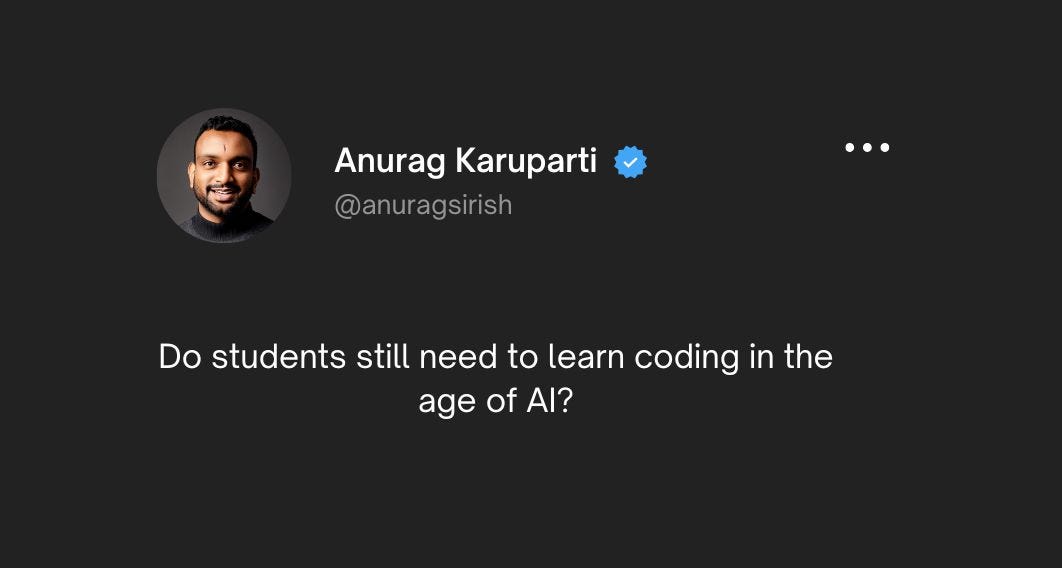
There’s an ongoing debate about whether learning to code is still necessary in the Age of AI.
Here’s my perspective on why coding remains an invaluable learning experience for young students, offering long-term benefits that extend far beyond programming itself.
Core principles of enhancing intelligence, such as logical structuring and systematic problem-solving, have long been recognized as essential for cognitive growth. These principles form the foundation of effective learning and reasoning, making them invaluable in human development and beyond.
We have seen this in the training of LLMs as well. Training LLMs on code leverages these same principles to significantly enhance their reasoning capabilities. The structured logic and precise syntax inherent in programming languages strengthen logical thinking and enable these models to excel across a wide range of tasks beyond coding.
What makes this approach particularly fascinating is how the timeless methods for sharpening human intelligence are mirrored in the training of advanced AI systems. This connection highlights the universal relevance of these principles in fostering cognitive capabilities, whether for humans or artificial intelligence.
Research supports this idea. Learning to code has been shown to improve problem-solving skills, logical reasoning, and creativity. For instance, a study published in Frontiers in Psychology highlights how programming enhances critical and creative thinking, both essential skills for the 21st century.
Coding is far more than a technical skill; it’s a powerful tool for cognitive development. By learning how to code, students learn essential skills to thrive in an increasingly technology-driven world, ensuring they not only adapt to but also shape the future!