
Ep. 8- How Microsoft Quietly Cracked Agentic AI
A practitioner’s look at how Foundry is collapsing the complexity of agent development into one unified platform. Key takeaways from Ignite 2025.

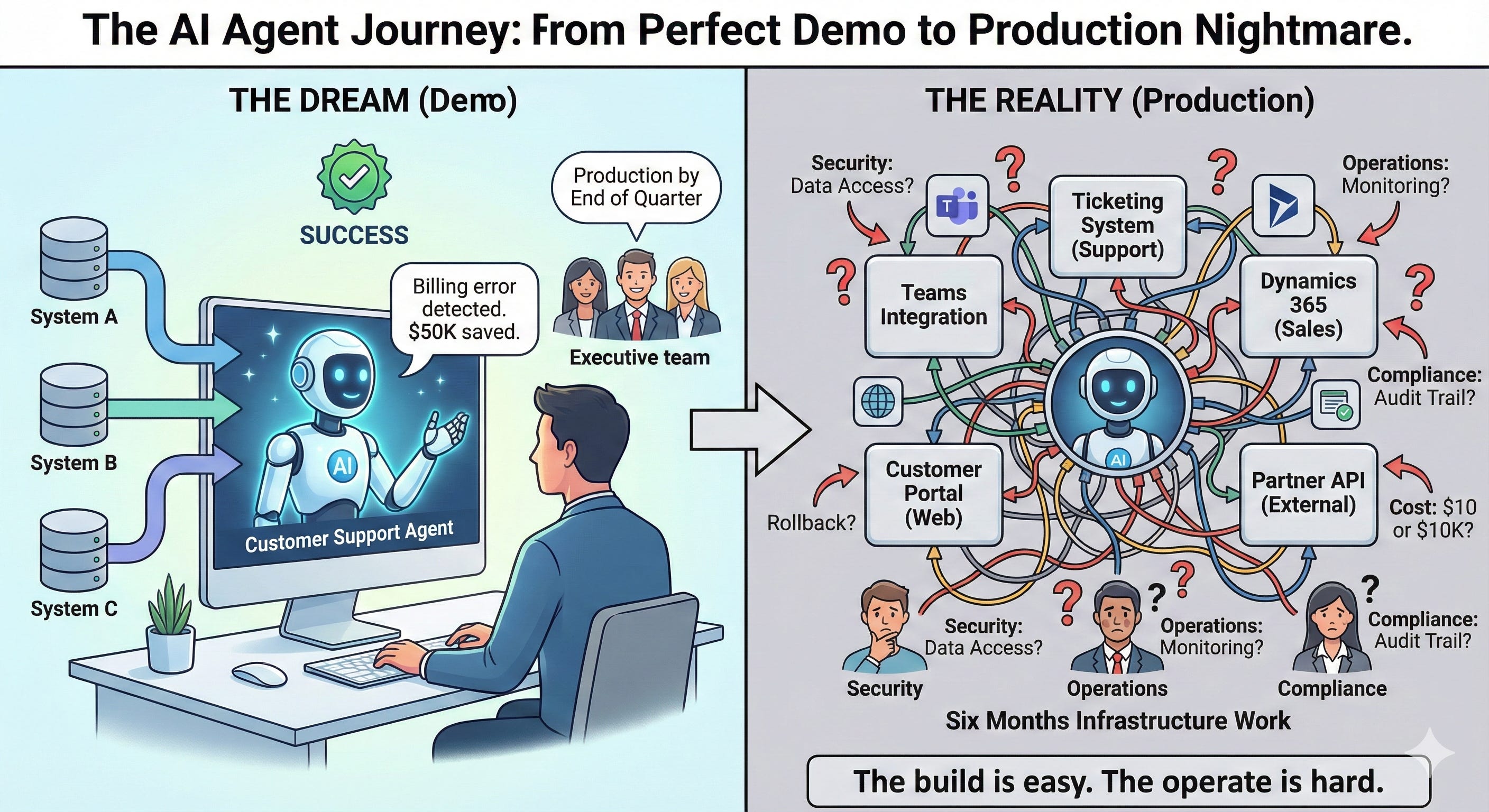
Your AI team just demoed their customer support agent to the executive team. It was flawless.
The agent answered complex questions, pulled data from three different systems, escalated appropriately, and even caught a billing error that would have cost the company $50K. The CTO wants it in production by end of quarter.
Then reality hits.
How do you embed it into Teams without rebuilding the whole thing? Your support team wants it integrated with their ticketing system. Sales needs it accessible through Dynamics 365. The web team needs it on the customer portal. Partners want API access.
You built one agent. now you need five different integration projects.
The security team wants to know: Who approved these data access policies? How do you ensure the agent can’t access customer payment info when it shouldn’t? What happens when it makes a mistake?
The operations team asks: How do you monitor if it’s working across 10,000 daily conversations? How do you roll back if the new version starts hallucinating? How do you know if it’s costing $10 or $10,000 per day to run?
The compliance team has questions too: Can you prove the agent didn’t share PII inappropriately? Can you show an audit trail of every decision it made?
Your perfect demo just turned into six months of infrastructure work.
This is why most AI agents never make it to production. The build is easy. The operate is hard.
The Real Problem
The conversations around AI agents have been stuck in the same place for months. Everyone’s talking about better prompts, smarter models, longer context windows.
We’re solving the wrong problem.
The real bottleneck isn’t how well an agent can chat. It’s how safely and reliably it can act.
The Operating Model Shift
Here’s what the new features announced at Microsoft Ignite 2025 in Foundry represent: the recognition that agentic AI needs a fundamentally different operating model than chatbots.
Chatbots respond. Agents execute.
That difference changes everything about how you build, deploy, and govern AI systems.
When an agent can actually take action - it triggers workflows, modify data, interact with systems you need:
Rock-solid guardrails, not just content filters
Audit trails for every decision
Rollback capabilities when things go wrong + agent versioning
Permission boundaries that actually work
This isn’t about making agents smarter. It’s about making them safer to operate at scale.
The Real Developer Challenges
Look at what developers actually struggle with across the agent lifecycle:
Build phase:
How do I know which model will give me the right balance of accuracy, speed, and cost for my use case?
How do I connect the right data sources, APIs, and tools securely, so my agent has the context and authority to actually take action?
How do I trace why my agent made a decision or failed, across prompts, models, and tools?
How do I get multiple agents to collaborate reliably? Share state, recover from errors, and stay aligned on a single goal?
Deploy phase:
How do I embed an agent seamlessly into front-end channels like Teams, Slack, or custom web apps?
How do I expose my agent in production via UI, API, and agent protocols without rewriting my code?
How do I roll out new agent versions into live apps safely—routing to live users and meeting compliance?
Operate phase:
How do I monitor cost, performance, and usage across agents so I can spot issues early?
How do I enforce compliance and data access policies so I can scale safely without constant manual oversight?
How do I detect and mitigate unsafe or failed behaviors to protect users?
How do I roll out updates and improvements safely, so I can innovate fast without breaking live systems?
These aren’t chatbot problems. These are production system problems.
And the reason most AI agents never make it past the demo stage is that companies don’t have answers to these questions.
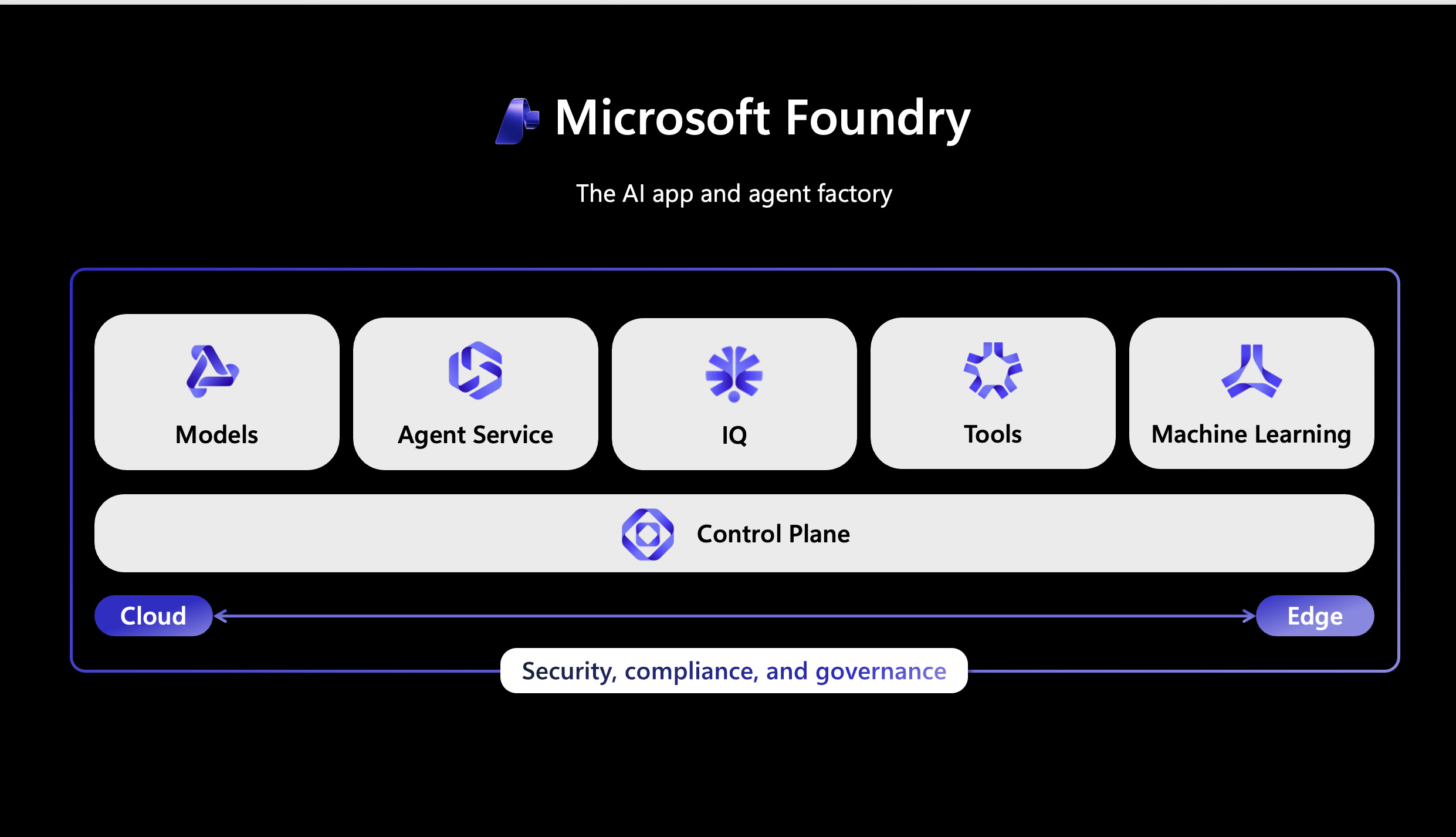
Foundry’s Answer: Discover, Build, Deploy, Operate
Foundry tackles this through a complete lifecycle approach:
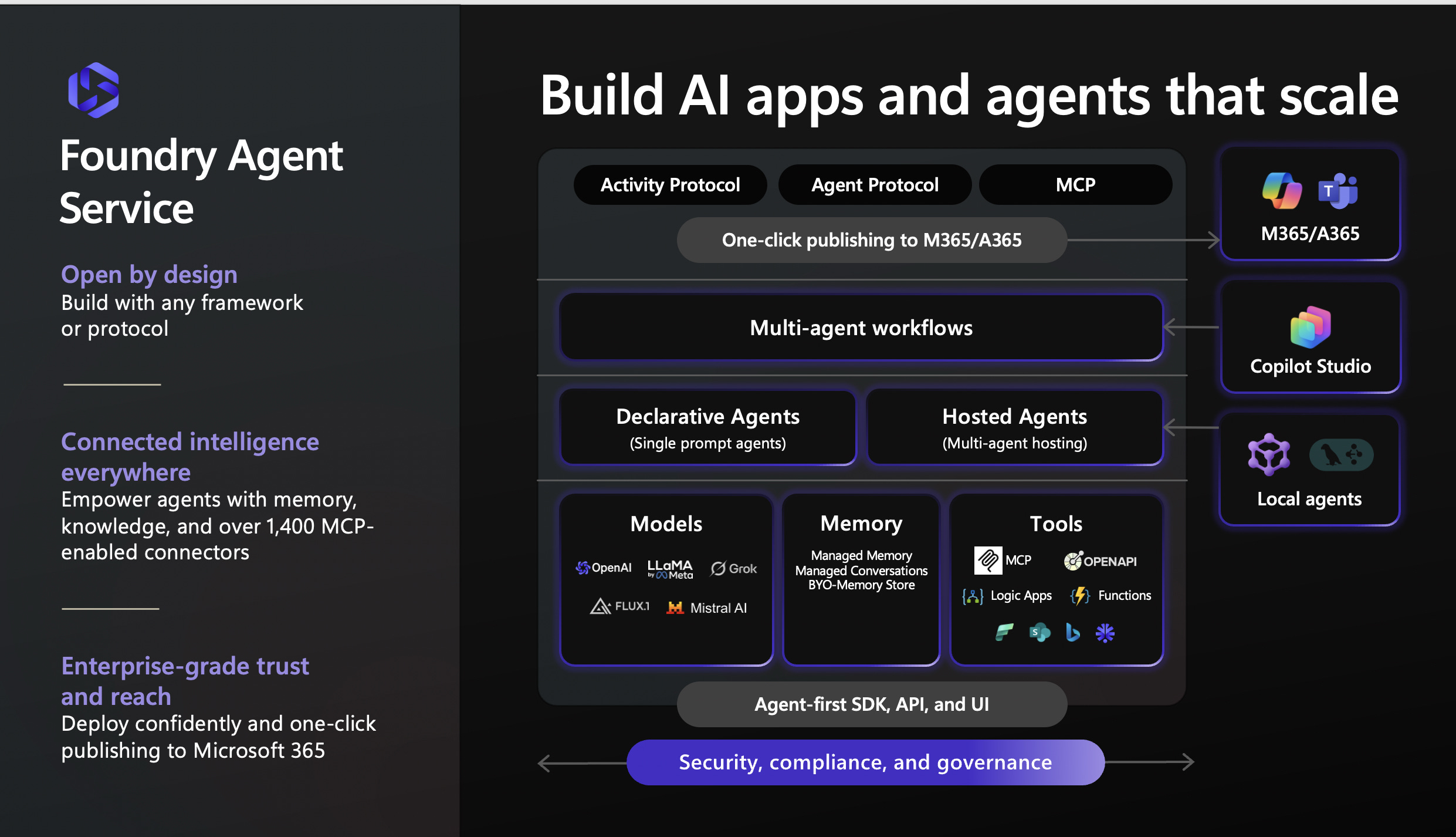
Build faster: Fine-tuning, memory, synthetic data generation, FoundryIQ + FoundryIQ+ WorkIQ for knowledge layer and agentic retrieval. Multi-agent orchestration with automatic code generation. Bing grounding for real-time information. This is the infrastructure that makes agent development practical, not just possible.
The key fundamental shift: we’re moving from natural language understanding to execution. From systems that respond to systems that act. That requires different tooling, different testing, different thinking.
Deploy safely: Publishing agents to teams, embedding them into existing channels, exposing them through multiple protocols. CICD functionality built in. Hosted agents so you can bring your own agents from LangGraph. The deployment layer is core to the platform.
Operate with confidence: Tracing and evals for quality and safety before and after deployment. The control plane keeps humans in the loop where it matters. You can monitor, enforce policies, detect failures, and roll out improvements without breaking production.
And with Microsoft Purview extending to agents, your existing data security infrastructure - DLP policies, sensitivity labels, access controls automatically applies to autonomous systems.
If a user can’t share confidential data externally, neither can an agent. You get real-time behavioral monitoring, automated risk detection, and compliance-ready audit trails without building a separate security model for AI.
This is the evolution from “we built an agent” to “we operate agents at scale.”
Goal-Seeking vs. Prompt-Following
The shift Foundry enables is from prompt-following to goal-seeking.
Traditional AI: “Write me an email to the sales team.”
Agentic AI: “Increase Q4 pipeline by 20%” and the system figures out the steps.
This is the evolution from natural language interfaces to execution engines. The AI doesn’t just understand what you want; it determines how to achieve it, coordinates across multiple systems, and reports back on outcomes.
But here’s the catch: goal-seeking systems that can take real action need connected infrastructure.
They need to safely access your CRM, your ERP, your collaboration tools. They need permission models that understand context, not just roles.
Multi-agent orchestration makes this practical. You don’t build one massive agent that does everything. You build specialized agents that coordinate through workflows, each with clear boundaries and responsibilities.
Why This Matters for Enterprise
If you’re building an AI Center of Excellence, Foundry represents the platform layer you need for agentic systems.
Most companies are still thinking about AI governance in terms of model access. That worked fine for chat interfaces. It’s completely inadequate for agents that execute.
You need:
Orchestration infrastructure that can coordinate multi-step workflows across multiple agents
Security boundaries that understand agent actions, not just API calls
Observability into what agents are actually doing in production like tracing, evals, cost monitoring
Golden paths that make it easy for teams to build agents the right way with compliance and safety baked in
Deployment flexibility so agents can surface through Teams, Slack, APIs, or custom apps without code rewrites
This is what separates AI experimentation from AI production. The companies that figure out the operating model for agentic AI. Not just the model selection will be the ones that actually drive automation at scale.
The Real Unlock
Foundry isn’t just another AI platform. It’s Microsoft’s bet that the future of enterprise AI is about connected, goal-seeking systems that take action.
Not better chats. Not smarter prompts.
Powerful automation.
The shift from natural language understanding to execution capability is the fundamental transition that makes agentic AI actually useful in the enterprise.
Everything else like model quality, context length, reasoning ability matters only if you can safely deploy agents that act.
If you’re still thinking about AI as a chatbot problem, you’re optimizing for the last generation of the technology.
The next frontier is operational: How do you build, govern, and scale systems that don’t just respond, but execute?
Foundry gives you the infrastructure to answer that question. The control plane, the deployment flexibility, the observability these aren’t nice-to-haves. They’re the foundation for making agentic AI work in production.
AI agents have become easy to build. Operating them at scale is still the hard part.
That’s the problem Foundry solves.
But here’s what happens when agents actually succeed in production:
You’ll have five agents next quarter. Twenty by year-end. IDC predicts 1.3 billion agents by 2028. Most of them won’t be built by your team. They’ll come from partners, open-source frameworks, shadow IT, and acquisitions.
How do you manage agents you didn’t build?
How do you enforce security policies across agents from different platforms?
How do you prevent one compromised agent from accessing resources it shouldn’t?
How do you audit what 100 agents did last Tuesday?
The operating model that works for deploying your first agent breaks completely at scale.
Which is why building agents is only half the story. Governing them at enterprise scale is the other half and it’s the harder problem.
More on that on my next Substack post.
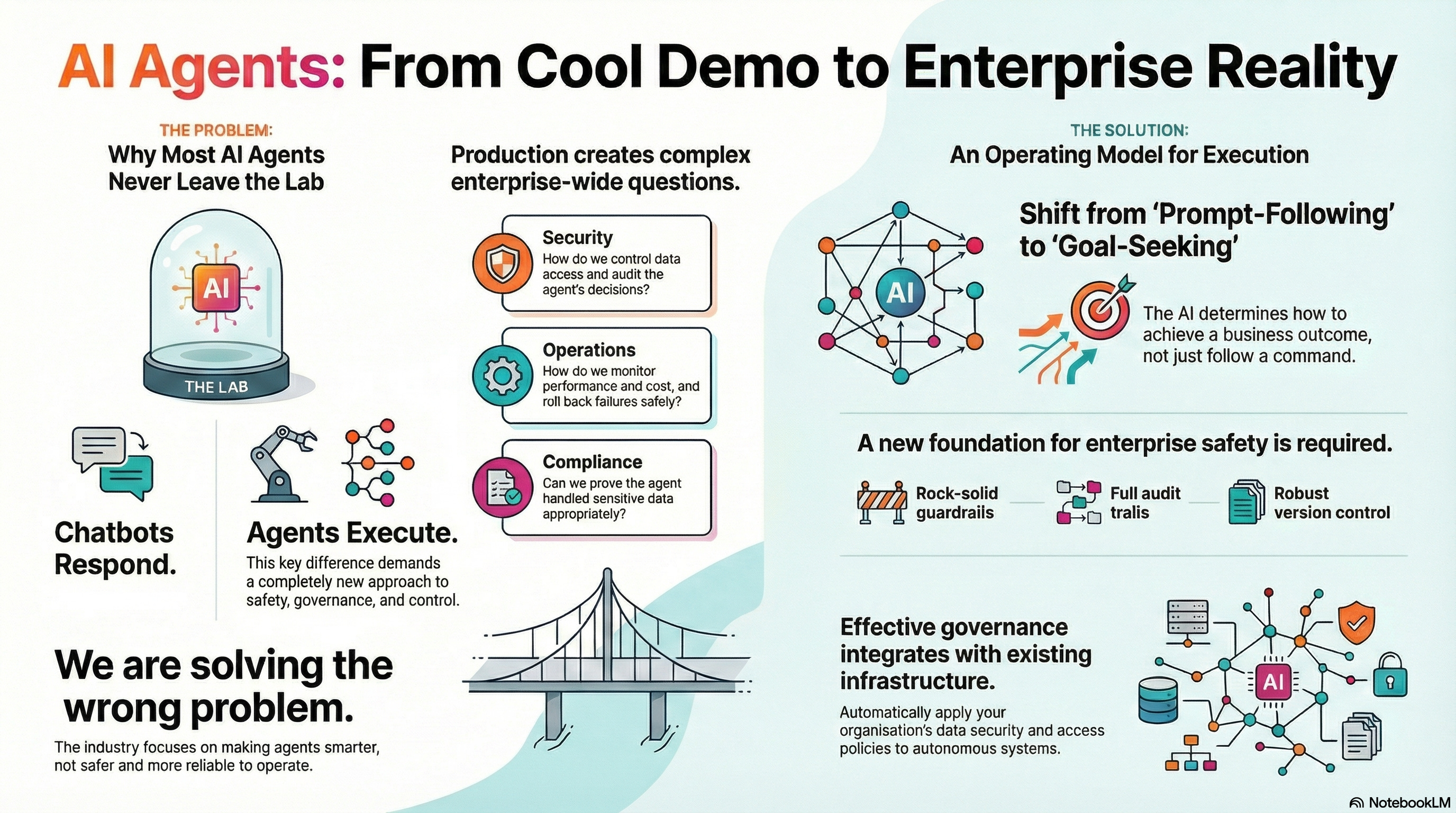
Also, if you missed my last post on Agent Orchestration Patterns, I made an animated video with NotebookLM (yes, I used AI to explain AI—very meta). Check it out on my YouTube channel, and subscribe if you want more of this experiment.
References:
Ignite Session: AI Agents in Microsoft Foundry, ship fast, scale fearlessly. https://ignite.microsoft.com/en-US/sessions/BRK189?source=/schedule
Purview for Agent365: https://techcommunity.microsoft.com/blog/microsoft-security-blog/announcing-new-microsoft-purview-capabilities-to-protect-genai-agents/4470696
Foundry IQ: https://techcommunity.microsoft.com/blog/azure-ai-foundry-blog/foundry-iq-unlocking-ubiquitous-knowledge-for-agents/4470812
That shift from prompt-following to goal-seeking is what everyone keeps missing. Foundry's actually addressing the whole deploy/govern issue, not just throwing more tokens at the problem. The Purview integration extending to agents makes way more sense than building parallel security from scratch.
The framing of 'build is easy, operate is hard' nails the actual blocker in enterprise agentic adoption. What resonates is your point about goal-seeking vs prompt-following, because it reframes the entire infrastructure conversation. When agents move from chat interfaces to execution engines, you're not just adding observability,your're fundamentaly changing what production-readiness means. The Purview integration is particulary clever since it lets orgnaizations extend their existing security model rather than inventing a parallel governance layer for AI.